We often talk about trying to find better, more innovative and engaging ways of sharing complex thoughts, ideas and data with large groups of other people. Thanks to Jenna Mandel-Ricci who shared this video in PH 710. The video clip (simlar to YouTube for those of you familiar with that) is a brief (7 minutes, with brief commercials at the beginning and end) presentation by Dr. Hans Rosling, a professor of international health at Sweden’s world-renowned Karolinska Institute, and founder of Gapminder, a non-profit that seeks to "bring vital global data to life" by developing and distributing free software. Rosling demonstrates some of this software in his presentation about global health, discusses a little about the vision of his non-profit organization, and is clearly energetic and enthusiastic here in this talk, recorded February, 2006 in Monterey, CA. The occasion is The Technology Entertainment Design Conference, also known as TED, an annual conference self-described as "a global community of remarkable people and remarkable ideas." Dr. Rosling sets a new benchmark for us all in terms of presentation of complex data in easy to understand ways.
CLICK THIS LINK TO WATCH THE VIDEO.
Wednesday, October 11, 2006

Friday, July 28, 2006
eHealth Literacy and Internet Interventions: New Articles from JMIR

The Journal of Medical Internet Research is frequently a good resource for material on health-related technology research. A couple of recent articles are especially noteworthy.
A paper titled, "Internet Interventions for Long-Term Conditions: Patient and Caregiver Quality Criteria," by Cicely Kerr, Elizabeth Murray, Fiona Stevenson, Charles Gore, and Irwin Nazareth (J Med Internet Res 2006 (Jul 28); 8(3):e13), explores a patient-generated analysis of an online intervention.
And, a paper titled, "eHealth Literacy: Essential Skills for Consumer Health in a Networked World," Cameron D Norman, Harvey A Skinner (J Med Internet Res 2006 (Jun 16); 8(2):e9), reviews some of the important skills necessary for evaluating health information online.
Thursday, July 20, 2006
HIV Risk and Latino Gay Men: Free Web Seminar
I just got an email notice about a free web seminar with one of the leaders in the field of research on HIV risk among Latino gay men, Dr. Rafael M. Diaz. Here's the notice:
Understanding Latino Gay Men and HIV Risk: A Conversation with Dr. Rafael M Díaz
About this Web Seminar:
Latino gay men continue to be disproportionately affected by HIV/AIDS. Acción Mutua will host a web-based seminar to explore the contexts that put Latino gay men at risk for HIV infection/transmission. More importantly, we will discuss factors that help Latino gay men remain safe, healthy and strong and other issues around resiliency.
Who should sign up?
* Anyone working to prevent new infections/transmissions of HIV among Latino gay men and other men of color
* Anyone seeking to understand the social and cultural context of HIV risk
* Anyone who wants to explore what makes Latino gay men resilient in the face of the HIV/AIDS epidemic
Participants in this seminar will discuss:
Ø The social and cultural context of what it means to be a Latino gay man
Ø The impact of racism, homophobia, and poverty on Latino gay men
Ø How to build upon Latino gay men's individual and collective strengths
*Seminar approach:
We encourage participants to submit questions in order to make the seminar interactive and responsive to their particular concerns. Submit questions between now and the day of the seminar to accionmutua@apla.org; entitle theemail "7/25 Seminar Questions."
Details:
This web seminar is FREE. Participants will log in to the appropriate website and call a toll free number to participate in the discussion.
RSVP: Please sign up by email at accionmutua@apla.org
You will receive instructions on how to log in and what number to call after you register.
DATE: Tuesday, July 25, 2006
TIME: 2:00-3:00 pm (Eastern time)
This is a great opportunity for any one interested in knowing more about HIV risk to learn from one of the leaders in the field.
Understanding Latino Gay Men and HIV Risk: A Conversation with Dr. Rafael M Díaz
About this Web Seminar:
Latino gay men continue to be disproportionately affected by HIV/AIDS. Acción Mutua will host a web-based seminar to explore the contexts that put Latino gay men at risk for HIV infection/transmission. More importantly, we will discuss factors that help Latino gay men remain safe, healthy and strong and other issues around resiliency.
Who should sign up?
* Anyone working to prevent new infections/transmissions of HIV among Latino gay men and other men of color
* Anyone seeking to understand the social and cultural context of HIV risk
* Anyone who wants to explore what makes Latino gay men resilient in the face of the HIV/AIDS epidemic
Participants in this seminar will discuss:
Ø The social and cultural context of what it means to be a Latino gay man
Ø The impact of racism, homophobia, and poverty on Latino gay men
Ø How to build upon Latino gay men's individual and collective strengths
*Seminar approach:
We encourage participants to submit questions in order to make the seminar interactive and responsive to their particular concerns. Submit questions between now and the day of the seminar to accionmutua@apla.org; entitle theemail "7/25 Seminar Questions."
Details:
This web seminar is FREE. Participants will log in to the appropriate website and call a toll free number to participate in the discussion.
RSVP: Please sign up by email at accionmutua@apla.org
You will receive instructions on how to log in and what number to call after you register.
DATE: Tuesday, July 25, 2006
TIME: 2:00-3:00 pm (Eastern time)
This is a great opportunity for any one interested in knowing more about HIV risk to learn from one of the leaders in the field.
Pew Report on Bloggers
There's a new Pew Internet and American Life study out, about bloggers:
"The Pew Internet Project blogger survey finds that the American blogosphere dominated by those who use their blogs as personal journals. Most bloggers do not think of what they do as journalism. Most bloggers say they cover a lot of different topics, but when asked to choose one topic, 37% of bloggers cite “my life and experiences” as a primary topic of their blogs. Politics and government ran a very distant second with 11% of bloggers citing issues of public life as the main subject of their blog. Entertainment-related topics were the next most popular blog-type, with 7% of bloggers, followed by sports (6%), general news and current events (5%), business technology (4%), religion, spirituality or faith (2%), a specific hobby or a health problem or illness (each comprising 1% of bloggers). Other topics mentioned include opinions, volunteering, education, photography, causes and passions, and organizations."
Of interest here, is the part I put in bold above, a "specific ... health problem or illness" which makes up 1% of bloggers. An interesting juxtaposition to another finding from the Pew about the fact that health-related information is one of the most often searched for items in people's internet use. Taken together, I think this can only mean that health-related blogs are going to increase over time.
"The Pew Internet Project blogger survey finds that the American blogosphere dominated by those who use their blogs as personal journals. Most bloggers do not think of what they do as journalism. Most bloggers say they cover a lot of different topics, but when asked to choose one topic, 37% of bloggers cite “my life and experiences” as a primary topic of their blogs. Politics and government ran a very distant second with 11% of bloggers citing issues of public life as the main subject of their blog. Entertainment-related topics were the next most popular blog-type, with 7% of bloggers, followed by sports (6%), general news and current events (5%), business technology (4%), religion, spirituality or faith (2%), a specific hobby or a health problem or illness (each comprising 1% of bloggers). Other topics mentioned include opinions, volunteering, education, photography, causes and passions, and organizations."
Of interest here, is the part I put in bold above, a "specific ... health problem or illness" which makes up 1% of bloggers. An interesting juxtaposition to another finding from the Pew about the fact that health-related information is one of the most often searched for items in people's internet use. Taken together, I think this can only mean that health-related blogs are going to increase over time.
Friday, July 14, 2006
Visionary Behind Wifi in Parks
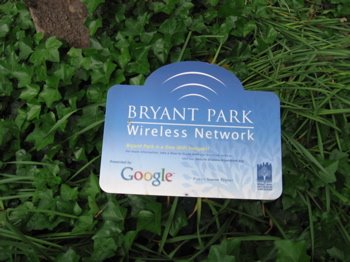
Personally, I can't wait for the wifi spots in Central Park to go live so I'm following this story closely. In this morning's NYTimes, there's a piece about Marshall Brown the visionary behind the wifi project for the city's parks, who "dreams of the wireless bubble on a grandiose scale," according to the article. I thought this quote from Brown was interesting:
“The first end of Internet expansion was about globalization, but this second phase of wireless Internet is going to be about the Internet made local.” His niche: for example, “What we’re going to enable by installing our portals in the parks is for people to get more in touch with where they happen to be.”
Brown also seems to have a desire to adddress some educational issues with this technology. The wifi hotspot just activated in Battery Park will usher users in through a portal that will offer a historical slide show, a tour of the Dutch gardens, and a video-cam hookup to the Statue of Liberty. As the article states, "In Mr. Brown’s wireless neighborhoods, connectivity is accompanied by educational content."
That's an interesting concept, providing educational content via portals at the free wifi spots. And, it seems like a great opportunity for the City Department of Health, or others interested in public health, to get out a message.
Wednesday, July 12, 2006
Black Gay Bloggers Protest Homophobia

Ran across this in Newsday.
"A reggae concert meant to raise awareness about HIV/AIDS is coming under fire from some black gay bloggers and activists who are incensed that the lineup includes two artists they consider to be anti-gay.
Among those scheduled to perform at the July 18 show at Webster Hall are Jamaican dancehall artists Beenie Man and the group T.O.K. Protesters have asked the concert's organizer, LIFEbeat - The Music Industry Fights AIDS, to drop them or force them to publicly denounce controversial lyrics in their songs.
'The idea that they would invite artists who encourage murdering gays and lesbians is so outrageous, insulting and unbelievable,' activist Keith Boykin said.
But concert organizers, while rejecting the anti-gay lyrics, said including the commercially successful performers in the show would allow them to reach an audience they otherwise wouldn't get to, pointing out that dancehall, a beat-driven form of Jamaican music, remains hugely popular despite controversy over its lyrical content.
John Canelli, LIFEbeat's executive director, said he felt strongly that the performers' presence would 'create dialogue around AIDS and the Caribbean-American community" and an "opportunity for groundbreaking change and good to come from it.' The artists aren't being paid, he said."
Monday, July 10, 2006
Secret Lives of Teens Online

There's been much hoo-ha (that being the technical term for it) in the old, broadcast media of late about the 'secret lives of teens online,' such as this report from a TV station in Portland, Oregon. And, has anyone watched the reports on Dateline recently? It's as if there's a producer there with a vendetta against the Internet.
And today, via Howard Rheingold, some reason has been re I learned of a newly released research from Professor Larry Rosen at UC-Dominguez Hills. Rosen finds that "only 7% of teens interviewed had ever been approached by anyone with a sexual intent and nearly all of them simply ignored the person or blocked the page." The research isn't based on a random sample (but rather a convenience sample), so it's not generalizable to all teens, or even all teens online. It's interesting, nonetheless, as a counter to the hyperbole and moral panic surrounding sexual predators online.
You can download a press release about Rosen's research here (downloads as a PDF file).
Friday, July 07, 2006
Convergence, Terrific Peer-Reviewed Journal on New Media
I just came across a wonderful journal, called Convergence, The International Journal of Research into New Media. In publication since 1995 (though I just learned of it) today, and based in the UK, full text articles are available from Hunter College library starting from 2004. (Use the "Electronic Journals" link from the main Wexler Library page, and search for Convergence.)
Thursday, July 06, 2006
HIV Blogs

The magazine POZ created by, for and about the HIV+ community, has created a new and innovative approach to publishing online with its'roster HIV Blogs, including one by the Editor-in-Chief, Regan Hofmann. More and more, CEO's, editors, and other top level management-types are creating their own blogs (or, having someone else write a blog that has their name on it), and it's good to see this take off in a health-related field. However, the well-intentioned folks at POZ have made the classic public health (and beyond) blunder of not including enough voices (or, in this instance blogs) by people of color. Given the increasing impact of HIV on communities of color, and particularly women in those communities, it's shocking that of the HIV Blogs listed at POZ, only one is by a woman of color.
Resource for Peer-Reviewed Articles about e-Health Education
I ran across what looks to be a valuable resource for peer-reviewed articles about health education and technology, with an international focus. It is The International Electronic Journal of Health Education.
A bit more about the journal from their author guidelines:
"International health education and promotion including articles that focus on programs and research in countries outside the US and articles from within the US that deal with immigrant populations or international outreach activities such as study abroad programs.
Health education and promotion articles are welcome that are most effectively published using the technology available through the Internet. Examples might include reports of computerized health assessments or audio/visual intervention programs. Articles might be accompanied by computer software, PowerPoint presentations, website links or a/v streaming to demonstrate a technology based project or product. These articles may originate from any geographic location, however it will be essential for authors who submit a technology based article to demonstrate the centrality of computer or Internet technology to either the content or presentation of the article."
It's definitely worth browsing their online table of contents for the past couple of years to see if there's anything relevant to your current health / education / technology interests.
A bit more about the journal from their author guidelines:
"International health education and promotion including articles that focus on programs and research in countries outside the US and articles from within the US that deal with immigrant populations or international outreach activities such as study abroad programs.
Health education and promotion articles are welcome that are most effectively published using the technology available through the Internet. Examples might include reports of computerized health assessments or audio/visual intervention programs. Articles might be accompanied by computer software, PowerPoint presentations, website links or a/v streaming to demonstrate a technology based project or product. These articles may originate from any geographic location, however it will be essential for authors who submit a technology based article to demonstrate the centrality of computer or Internet technology to either the content or presentation of the article."
It's definitely worth browsing their online table of contents for the past couple of years to see if there's anything relevant to your current health / education / technology interests.
Wifi Arrives Soon in NYC Public Parks

From today's New York Times:
By the end of August, wireless networks will be established at 18 locations in 10 of New York City's most prominent parks — including Central, Prospect and Riverside Parks — in a major citywide expansion of free Internet access, according to city officials."
In my view, this is a great news for the city and for urban public health. Spreading wifi networks throughout the city's parks is a small but important step toward a framework that conceptualizes Internet access as a digital entitlement (to use Mansell's phrase) as well as an incremental move toward bridging various digital divides in the city. These impact health in a variety of ways, including but not limited to, greater access to health information that is available online. In some ways, I see the expansion of the wifi network in the city as analogous to the expansion of education in this country two centuries ago.
You can read the full article here (free registration required).
Wednesday, July 05, 2006
More about Podcasting and Health
Interesting presentation this evening by Iskra and Tara about podcasting and public health. I thought I'd add to the conversation with a couple of additional links.
If you're interested in creating your own podcasts, Apple provides some fairly extensive instructions on how to do it here. You can use iTunes (a free download here) to browse through a catalog of different types of podcasts.
There are also competitors to iTunes, such as Gcast, which offers free podcasting.
And, bringing this back around to health, on the Gcast site you'll notice that they're affiliated with Bono's ONE Campaign to fight HIV/AIDS. Pretty cool.
If you're interested in creating your own podcasts, Apple provides some fairly extensive instructions on how to do it here. You can use iTunes (a free download here) to browse through a catalog of different types of podcasts.
There are also competitors to iTunes, such as Gcast, which offers free podcasting.
And, bringing this back around to health, on the Gcast site you'll notice that they're affiliated with Bono's ONE Campaign to fight HIV/AIDS. Pretty cool.
Literature Review - Deadline Extended
I sent this to everyone via Hunter email this morning, but several of these have bounced back (or been returned as undelivered for past 4 hours), so I'm posting this here. Apologies if you're just now getting word.
Several people have written to ask for extensions on the literature review. Rather than make individual exceptions, I'm extending the deadling for lit reviews until Friday, 7/7 @ 5pm. I still want hard copies (printed on paper), and would like them in my mailbox on the 10th floor ("J. Daniels" under the "Adjunct Faculty"). DO NOT, under any circumstances, slip paper copies under my door. These get thrown away by custodial staff.
Several people have written to ask for extensions on the literature review. Rather than make individual exceptions, I'm extending the deadling for lit reviews until Friday, 7/7 @ 5pm. I still want hard copies (printed on paper), and would like them in my mailbox on the 10th floor ("J. Daniels" under the "Adjunct Faculty"). DO NOT, under any circumstances, slip paper copies under my door. These get thrown away by custodial staff.
Friday, June 30, 2006
The Environment, Bodybuilding & Race, from Two Favorites

A couple of favorite blogs have recently included (broadly) health-related posts, so I will close out the week with a few comments about each.
I've already mentioned the briliant writing of Twisty-Faster and her patriarchy-blaming ways. And, she recently saw the Al Gore film which she refers to as a globalwarmingumentary. God knows I love a made up word and that's a doozy. Ms. Twisty mentions this blurb from NPR which perpetuates the myth of global warming as a 'controversy," noting in her inimitable style: "NPR. Ever since they got that Bushite pit boss, you’ve really gotta keep your eye on’em." Love her.
And, from my other favorite blog, Liz over at Granny Gets a Vibrator, writes about her experiences with personal training. Liz, who is white, tells a story of working out with an African American woman, and a conversation ensues about black-white body differences. As it turns out, African Americans on average, "tend to have greater bone density than white people, different patterns of fat distribution, and unique shapes to certain muscles." Then, she goes on to talk about a bodybuilding-buddy of hers who is an African American man, and who has "high short calves." She relates this back to the sport of bodybuilding and writes this:
"But even as I was expounding on the anatomy lesson, it occurred to me that of course there is nothing inherently wrong with Kevin's calves. They're strong and sturdy, hard as rocks, well developed and healthy, and they do a damn good job of supporting his enormous bulk. The only problem is that they don't quite meet the gold standard for bodybuilders, which is--surprise!-- arbitrarily based on the average shape of white people's calves."
Bingo. Well-said, Liz!
Thursday, June 29, 2006
Gender, Time & the Push to Multi-Task

Interesting presentation last night in class by Kezzie Joseph about multi-tasking and the impact on women's health. As she notes on her blog, she sees "multi-tasking [as] more of an woman's health issue," and I wanted to expand a little on that idea.
So, why is it do you think that women, more so than men, feel so pressed for time that they are risking their health? While you may have heard about the "wage gap," the fact that women still make less than men in paid employment, you may not have heard about the "leisure gap," wherein even in double-earner couples women have significantly less leisure time than men do. The reason for disparity in leisure time between women and men is primarily the result of the unequal allocation of housework and childcare. Overwhelmingly, women have the primary responsibility for housework and childcare, even when both partners work.
Given this inequality that shapes women's lives on a daily basis, it's no wonder that women feel pushed to multi-task. Of course, some women have advocated different strategies for resisting this inequality. Some have argued that housework should be paid labor. And, as I mentioned last night some people, women and men, are resisting all the ways our lives have sped up and are part of the Take Back Your Time movement.
Wednesday, June 28, 2006
Bayer Accused of Releasing Tainted Drugs in Foreign Countries

This story was originally reported a few years ago by CBS News, but I ran across it today via this student blog.
The story is that Bayer came out with a drug for hemophiliacs that was found to be tainted with the HIV-virus. The FDA blocked Bayer from releasing the drug in the U.S., but the company went ahead and sold it in France, Spain and Japan. Bayer, of course, denies any wrong-doing.
I wanted to post this story for a couple of reasons. One, so that I could mention Progressive U, which bills itself as "the new media voice for students," and seems to be a growing portal for young people interested in civic engagement through the Internet.
I also wanted to focus attention on the pharmaceutical companies who are in the business of "Selling Sickness," as author Ray Moynihan puts it. As Moynihan notes in his excellent book, even when pharmaceutical companies are not engaged in the kind of egregious behavior that Bayer is accused of, they are actively pursuing the creation of new diseases and conditions for which that they can then sell us "cures," at great profit to them and tremendous cost to the consumer. It's too bad Bayer felt the need to expand beyond the business of selling aspirin, which seems to be one of the few miracle drugs. Clearly, the huge profits of the pharmaceuticals are a higher priority for them than good health. And, these profits, in turn, influence politics in Washington around health care. No wonder we have no national health care.
Tuesday, June 27, 2006
TechSoup, NetSquared and Blogging for Justice
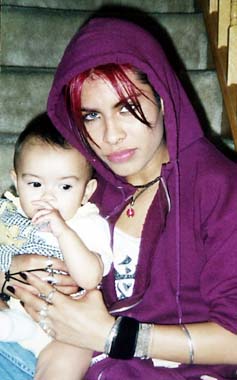
A few things worth noting from TechSoup. If you're not familiar with this organization and you work in a non-profit that makes any use of technology, I urge you to visit their website (linked above) and sign up for their newsletter.
If you can make it down to D.C. this Thursday, June 29, there's an interesting conference on "Blogs, Wikis, and Workspaces," that will explore ways new technologies, like the ones we've been using in the course, can help public policy organizations be more effective and efficient.
TechSoup has also started a project called NetSquared, which is intended to help nonprofits harness Web technologies for social change. One of the social justice efforts highlighted on NetSquared is about "Justice for Gwen Araujo." In case you don't know, Gwen Araujo (pictured above) was a transgendered woman who was killed when her attackers learned she was biologically male. A community activist joined with others and blogged about the trial of Araujo's attackers. You can read more about it at the link above. I think it's a great example of the way Internet technology can be used for social justice.
Monday, June 26, 2006
Laptops for the Homeless
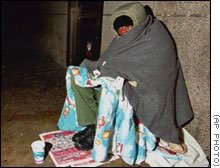
Circling back to this meme about how technology can improve the lives of the poor, there's an article from WIRED Magazine about laptops for the homeless, brought to my attention by Bill McIver on the Digital Divide Network listserv. Here's a brief bit from that article:
"Many of those now living without a permanent roof over their heads have cell phones in their pockets or laptop computers at their hips. While people living in shelters and alleys have found it difficult to cross social divides, the digital divide seems to disappear on the streets. Nearly all homeless people have e-mail addresses, according to Michael Stoops, director of the National Coalition for the Homeless. 'More have e-mail than have post office boxes,' Stoops said. 'The internet has been a big boon to the homeless.'
Helping the homeless get e-mail addresses has been a priority for years at shelters across the country. And in an age when most every public library in the nation offers internet access, the net has proven a perfect communication tool for those without a firm real-world address."
Clearly, there are some implications here for public health and public health practitioners. It might be possible to get health information to homeless people via email, and certainly those who want to work with this population need to know how to help people set up email accounts.
And, even more encouraging is this story:
"Terri Hellerich's connection to the information superhighway is all that made life livable on the streets. 'It kept me sane and provided my income,' she said. Hellerich found herself homeless after a landlord in West Sacramento kicked her out and kept her belongings to make up for a debt. She didn't have a change of clothes, but she did have an old cell phone that she could use to stay online and check her inbox.
Hellerich slept on benches but she frequented a women's shelter with a cluster of internet-connected computers used mostly by the children who arrived at the safe house with their mothers. She started blogging and conducting a business. As an independent internet marketer, she was able to maintain bank accounts, nurse existing client connections and forge new business relationships. The business brought in only about $100 a month, but that was enough to help get her life back on track."
The article goes on to mention the blogs of several other homeless folks, including Kevin Barbieux, a woman in the UK known as Wandering Scribe, Willie York, and another blog written by a young woman who wrote about being homeless and now has housing.
Friday, June 23, 2006
Anytime, Anywhere Learning Podcasts

Via Andy Carvin's Waste of Bandwidth, a series of podcasts from the anytime, anywhere learning foundation summit in Boston. Each podcast is about 45 minutes long, between 15 and 20 megabytes. To dowload and listen, click on the name of each speaker below.
Ben Shneiderman:
Ben is the author of Da Vinci's Laptop, and is a computer scientist/edtech researcher at the University of Maryland. He talks about the need to make students ecstatic about learning, using authentic, interactive learning experiences that positively affect the community. He also talks about his work with Hive Group, developing web-based visualization tools for exploring complex data sets.
Mike Furdyk:
Mike is one of the founders of TakingITGlobal.org, the global youth activism network. He talks about his life growing up with technology from the time he was a toddler, and how it led to him creating an online community where young people can come together to affect positive social change.
Tim Magner:
Tim is the director of the Office of Education Technology at the US Department of Education. In his presentation, he offers a broad overview of emerging technologies, from mobile devices to nanotechnology, and examines the role these tools should play in education and educational management.
Although these are all focused only on "education and technology," I think each of these has clear relevance for health communication.
Subscribe to:
Posts (Atom)