- Health Reform Video Challenge - President Obama wants you....to create a video. Seriously, he does. This is the challenge: "Create the best 30 second video you can that makes the case for passing health insurance reform in 2009." Interested? Here are the official rules. I would love to see a submission from our class.
- Stranger than Fiction (STF) - STF is a documentary series at IFC Center, and it is launching its' 11th year. This is a great chance to see documentaries screened in a theater, often with filmmakers present afterward for Q&A. I hope to see you there!
- Get in on the ground floor - Check the notice I posted on Blackboard about the opportunity to get in on the ground floor of work on a doc about desegregation in health care with a professor here at Hunter. Really, someone needs to do this.
- Maysles Institute - The Maysles brothers are the filmmakers that brought us "Grey Gardens" (among other films), and we're fortunate that the surviving brother lives here in New York. Check out the Maysles Institute and their ongoing film series uptown, at the Maysles Cinema, 343 Malcolm X Blvd / Lenox Ave (Between 127th and 128th Streets). A treasure of an institution - not to be missed.
Tuesday, September 29, 2009
Opportunities Abound ~
Opportunities abound for both seeing and creating documentaries and new media projects. Here are few that have come to my attention recently:

Tuesday, September 22, 2009
Public Health 2.0
JRanck has provided a terrific report that offers a descriptive overview of what we might call, "Public Health 2.0" - riffing on "Web 2.0" (hat tip: @MindofAndre). This is definitely worth a few minutes of your time:
Public Health 2.0: Re-Mixing Public Health
See especially about page 12 where he mentions Social Documentary and Witness as examples of the way that visual media are being deployed in the new technological landscape.
Public Health 2.0: Re-Mixing Public Health
See especially about page 12 where he mentions Social Documentary and Witness as examples of the way that visual media are being deployed in the new technological landscape.
Sunday, September 20, 2009
HIV/AIDS in the Caribbean: A Deadly Cycle of Stigma and Secrecy
I heard about this health-related documentary screening via my church bulletin this Sunday and thought I would pass this along:
HIV/AIDS in the Caribbean: A deadly cycle of stigma and secrecy (documentary screening) Stigma and discrimination prevent people around the world from accessing the HIV prevention, care and treatment services they need. This is particularly true in areas of the Caribbean, such as Jamaica, where anti-sodomy laws and concerns about violence put vulnerable populations at extreme risk. A panel of journalists, funders, AIDS activists and community members discuss the human impact of this discrimination, the need for coordinated multi-sectoral action, and journalism's role in bringing these issues to the broadest possible public.There is a panel discussion following the screening. More information here about the panelists.
Tuesday, September 22nd
4:00-5:30 pm
Reception following
CUNY Graduate School of Journalism
Room 308
219 West 40th St., NY, NY 10018
Seating limited: Please rsvp to rsvp@pulitzercenter.org
Tuesday, September 15, 2009
Documentary "Crude" with Filmmakers Present
The IFC Theater on W.4th is a good resource for independent and documentary films. They are currently screening "Crude," a new film by Joe Berlinger. Here's an excerpt from the blog linked to the film's website:
On Wednesday (9/16) and Thursday (9/17) at 7:55pm and Sunday (9/20) at 5:40pm the filmmakers will be present at the IFC Theater for a Q&A after the film. If you've never seen a documentary screened in a theater with the filmmakers present, you should definitely make it a point to go this semester.
Three years in the making, this cinéma-vérité feature from acclaimed filmmaker Joe Berlinger (Brother’s Keeper, Paradise Lost, Metallica: Some Kind of Monster) is the epic story of one of the largest and most controversial environmental lawsuits on the planet. The inside story of the infamous “Amazon Chernobyl” case, Crude is a real-life high stakes legal drama, set against a backdrop of the environmental movement, global politics, celebrity activism, human rights advocacy, the media, multinational corporate power, and rapidly-disappearing indigenous cultures. Presenting a complex situation from multiple viewpoints, the film subverts the conventions of advocacy filmmaking, exploring a complicated situation from all angles while bringing an important story of environmental peril and human suffering into focus.
The landmark case takes place in the Amazon jungle of Ecuador, pitting 30,000 indigenous and colonial rainforest dwellers against the U.S. oil giant Chevron. The plaintiffs claim that Texaco – which merged with Chevron in 2001 – spent three decades systematically contaminating one of the most biodiverse regions on Earth, poisoning the water, air and land. The plaintiffs allege that the pollution has created a “death zone” in an area the size of the Rhode Island, resulting in increased rates of cancer, leukemia, birth defects, and a multiplicity of other health ailments. They further allege that the oil operations in the region contributed to the destruction of indigenous peoples and irrevocably impacted their traditional way of life. Chevron vociferously fights the claims, charging that the case is a complete fabrication, perpetrated by “environmental con men” who are seeking to line their pockets with the company’s billions.
On Wednesday (9/16) and Thursday (9/17) at 7:55pm and Sunday (9/20) at 5:40pm the filmmakers will be present at the IFC Theater for a Q&A after the film. If you've never seen a documentary screened in a theater with the filmmakers present, you should definitely make it a point to go this semester.
Taking a Look at Wiseman's, "Titicut Follies"

Wiseman's work stands as an interesting case study in "independent documentary film making and in the legal, ethical, aesthetic, and rhetorical issues that the case has raised” (Anderson and Benson, 1991, p.4). It's also one of the earliest films that can be pointed to as a kind of social change film that the filmmaker really intended to use to bring about change in a social institution (but more about that in a moment). Before I get to that, let me review some of the background on the film and the controversy surrounding it.
Controversy: Just before the film was due to be shown at the 1967 New York Film Festival, the government of Massachusetts tried to get an injunction banning its release. The state claimed that the film violated the patients' privacy and dignity. Although Wiseman received verbal permission from all the people portrayed or the hospital superintendent (their legal guardian), Massachusetts claimed that this oral permission could not take the place of valid release forms from the inmates. It also claimed that Wiseman breached an "oral contract" giving the state government editorial control over the film. However, a New York state court allowed the film to be shown. In 1968, however, Massachusetts Superior Court judge Harry Kalus ordered the film pulled from distribution and called for all copies to be destroyed, citing the state's concerns about violations of the "patients' privacy and dignity." While "privacy and dignity" became the stated reason for stopping the film's distribution, and certainly a cause for concern, many critics of the court's decision - most notably Wiseman himself - argued that the state of Massachusetts, concerned that the film portrayed a state institution in a bad light, intervened to protect its own reputation.
Legal Limbo: Wiseman appealed to the Massachusetts Supreme Judicial Court, which in 1969 allowed it to be shown only to doctors, lawyers, judges, health-care professionals, social workers, and students in these and related fields. Wiseman appealed to the United States Supreme Court, which refused to hear the case. Thus, from 1969 for the next twenty years or more, Wiseman's film existed in this rather bizarre and completely unique, legal limbo in which distribution was blocked except for the screenings for certain kinds of 'professionals.'
Distribution: In 1991, Superior Court Judge Andrew Meyer allowed the film to be released to the general public, saying that as time had passed, privacy concerns had become less important than First Amendment concerns. He also said that many of the former patients had died, so there was little risk of a violation of their dignity.[2] The state Supreme Court has ordered that "A brief explanation shall be included in the film that changes and improvements have taken place at Massachusetts Correctional Institution Bridgewater since 1966."[12] The film was shown on PBS in 1992. The film is now legally available through the distributor, Zipporah Films, Inc., for purchase or rental on VHS, DVD and 16mm film for both educational and individual license. Zipporah Films released the DVD of the film to the home market in December 2007.
Medicalization: One of the key sociological concepts that we discussed in relation to this film is that of 'medicalization,' that is taking a normal behavior and re-framing it as a medical condition (verb form: to medicalize). Medicalization is a tool of social control. Thus, those with less social power - people who are poor, not adults, not white, not male, not able-bodied - are much more vulnerable to being medicalized. And, as we read in the Rosenhan piece, once a medical label has been attached to someone it is very difficult, perhaps impossible, to resist that labeling. In Wiseman's film, we see a powerful example of this process as "Vladimir," tries to talk his way out of Bridgewater. It is especially moving when he reflects on his own condition, saying “The reality is that I am here as a prisoner, and I am being ruined.”
Total Institutions: Known at the time as an institution for the "criminally insane," the Bridgewater State Hospital featured in the film still houses 386 inmates, although state officials say that the institution has been transformed since the days that Wiseman shot his film. In fact, all of Wiseman's films are concerned with social institutions: hospital, police, schools, and the family in the United States. Titicut Follies is unique in that it examines a total institution. Developed by sociologist Ervin Goffman, a total institution is an institution where all parts of life of individuals under the institution are subordinated to and dependent upon the authorities of the organization. Some examples of total institutions include boarding schools, concentration camps, colleges, cults, prisons, mental institutions, boot camps, monasteries, convents, nursing homes, and even cruise ships. Wiseman's film offers a rare glimpse inside a total institution.
Bodies Under Siege: The bodies that Wiseman portrays are largely bodies under siege by the institutions in which they live. As such, these bodies - naked, emaciated, under total institutional control and completely without autonomy - become symbolic representations of each of us, as individuals, within society. The body in the film which receives the most care is the dead body of the inmate – others are assaulted. Wiseman illustrates by editing together scenes of a man being force-fed via a tube down his throat and then the relatively good care being taken with the same man's corpse after his death. (For more on the way 'bodies' can be portrayed in film, there is a nice analysis here connecting Wiseman and Riefenstahl and how each filmmaker portrays bodies: http://www.brightlightsfilm.com/50/titicut.htm).
Privacy, Dignity and Direct Cinema (cinéma vérité): Wiseman's film is an example of 'direct cinema,' or cinéma vérité. Watching a film shot in this style gives the viewer the sense of being in the room with someone and watching the action unfold in real time. And, if you are used to the quick edits and jump cuts popular in much of visual media today (such as the "Girl Effect" video I posted yesterday) then this can seem a painful to watch at first until you allow yourself to relax into the pace of the film itself. The cinéma vérité style does raise some ethical issues, however. Here again are Anderson and Benson on this subject:
“Wiseman’s documentaries are built upon a method of film making that deliberately courts questions of invasion of privacy. To watch the films is often to feel as if we are seeing deeply into other people’s private experiences. In the Titicut Follies case, the issue of invasion of privacy became a legal issue; in all direct cinema it is an ethical and aesthetic issue.” (Anderson and Benson, 1991, p.4)So several questions present themselves here: is it possible to make a film about peoples' suffering and not, simultaneously, violate their privacy? Is it possible to create a film that both shows peoples' suffering and respects their dignity? And, who is to decide when this has been achieved? These are difficult, perhaps unanswerable, questions but ones that we will face again and again if we create visual media that includes images of health, illness and bodies.
In an interview, Wiseman speaks to how he sees his editing style as related to the issue of the dignity of his subjects:
Q: Could you talk about your editing style? A lot of movies and television shows today use lots of fast cuts. You seem to be in a different camp.
Wiseman: “I think I have an obligation, to the people who have consented to be in the film, to make a film that is fair to their experience. The editing of my films is a long and selective process. I do feel that when I cut a sequence, I have an obligation to the people who are in it, to cut it so that it fairly represents what I felt was going on at the time, in the original event. I don't try and cut it to meet the standards of a producer or a network or a television show.
My principal obligation is to make as good a movie as I can, and try to fairly represent the complexity of what went on. That means that sometimes the films are long, it means that sometimes the scenes are long. I don't think it's fair just to cut to the most sensational part of the scene, and then cut to another sensational scene, because that means that there's absolutely no context. In each scene, I have an obligation to provide the context and, from my point of view, the result is more dramatic than when you just cut to the most sensational aspect. The so-called juicy part of the scene is more comprehensible and more powerful because the context is clear.”
The Politics of Asking Permission: When the controversy over the film first began, Wiseman was quick to point out that he asked and received permission from all of the people portrayed in the film or their legal guardian, in this case the superintendent of Bridgewater. The larger question is: is it possible to get meaningful permission from someone to be in a film if they are incapacitated or if they are institutionalized? Does the permission of a legal guardian constitute meaningful consent? What about the permission of the superintendent in charge of the institution where one is an inmate? These are typically the sorts of questions that are asked of researchers when conducting research with human subjects, but these sorts of questions are relevant for documentary filmmakers as well.
Social Change: Little changed at the Bridgewater facility where the film was made until 1987. It was then that the families of seven inmates who died in the institution sued both the hospital and the state of Massachusetts. Steven Schwartz represented one of the inmates. Schwartz’s client was “restrained for 2 ½ months and given six psychiatric drugs at vastly unsafe levels - - choked to death because he could not swallow his food.” Schwartz claimed that the state's order to block distribution of Titicut Follies was implicated in his client's death:
“There is a direct connection between the decision not to show that film publicly and my client dying 20 years later, and a whole host of other people dying in between.”That's a remarkable claim for someone to make about a film: people died because this film was not released. While we may discount that as lawyerly-hyperbole, there may be some bit of truth to Schwartz's claim since as he went on to point out: "In the years since Mr. Wiseman made Titicut Follies, most of the nation’s big mental institutions have been closed or cut back by court orders.” In addition, “the film may have also influenced the closing of the institution featured in the film.”
However, trying to make the connection between one documentary film and broader social change - even relatively small social change, like closing one institution - can be a difficult claim to support, as Wiseman himself says in this interview:
Q: I'm interested in the idea of documentary film having some social utility. Could you speak to that?I would disagree only slightly with Wiseman's assessment here in that I think it is possible to measure, but I agree wholeheartedly that it's difficult. And, I think in many ways he captures something very important when he says that the effect of one film can be "elliptical, subterranean and circuitous."
Wiseman: “Well, it's very hard to know. It's very hard to measure. When I first started out, I had a rather naive and pretentious view that there was some kind of one-to-one connection between a film and social change. But now, while I like to think there might be a connection, I think there is no real way of knowing. People have all kinds of sources of different information, and it's totally presumptuous to assume that any documentary, or any one work of any sort, is going to be that important. Which is not to say I don't hope it has an effect, but I think if it does, it's elliptical, subterranean, circuitous and certainly not measurable.”
Truth and Fiction: Finally, any discussion of documentaries must also include a discussion of 'truth.' The documentary is a defined as a "non-fiction" film and thus carries with it a special burden of truth-telling. However, which truth gets told is entirely up to the filmmaker who decides what to shoot, what to include and what to edit out. Wiseman is aware of this tension and is, perhaps intentionally, flip about it when he says that documentaries are fiction:
“Documentaries, like theatre pieces, novels or poems are forms of fiction,” (Philippe Pilard, “Frederick Wiseman, Chronicler of the Western World,”originally published in La Sept/Arte, from here.)For good or for will, Wiseman is sometimes credited with being one of the originators of the contemporary genre known as "reality TV." Again, Anderson and Benson offer a bit of background on the blurring of the line between truth and fiction in Wiseman's work:
“Wiseman has sometimes referred to his films as reality fictions. The term was used by Wiseman as early as 1974 and at one level is a way of referring to the same problem John Grierson pointed to when he said that documentary film was about the ‘creative treatment of actuality.’ One works from social actuality but necessarily imposes form upon that actuality, turning it into what may be implied by the terms art or fiction. ” (Anderson and Benson, 1991, p.1)
Even as Wiseman protests that his films are "fictions" like a play or a novel or a poem, the fact is that we - as an audience - approach his work differently than if we were reading a poem or a novel or seeing a play. And, perhaps that's real distinction between truth and fiction, what we as an audience bring to each of these, and what we take away.
Monday, September 14, 2009
Girl Effect: Short Video
This is a short video (2:23) about the importance of universal education for girls (hat tip: Arlen). As you probably already know, there are a lot of positive health outcomes associated with higher education for girls, and this video drives home that point nicely in a very short amount of time:
Why does this work so well? What are the elements that give this short video impact?
Why does this work so well? What are the elements that give this short video impact?
Fall Semester, 2009: Visual Media, Technology & Health (PH 770)
I'm playing around with the title of this blog as I gear up for another semester of teaching the graduate course, "Visual Media, Technology & Health (PH 770)" at Hunter.
In the class, we see a lot of health-related documentaries, read a lot of critiques of those documentaries, and contemplate how documentaries are converging in interesting ways with new media, particularly when it comes to health and health campaigns.
Here's the course description:
Visual media – TV, documentary films, and YouTube - affect how we think about health, public health, illness and the body.
The Internet, once primarily a text-only medium, is increasingly a visual medium where people go to seek out TV shows, documentary films and shorter videos created especially for the web. And, content created specifically for television and movie theaters today typically includes a web-based component that allows interaction with audiences of various kinds. The overlap and coming together of different forms of media is what scholar Henry Jenkins as referred to as “convergence culture.” A significant portion of this visual content in this convergence culture deals with individual and public health, illness and the body.
Visual messages are increasingly the format of choice for communicating message about health. For example, when the National Institutes of Health (NIH) and National Institute of Drug Addiction (NIDA), wanted to get out a public health message that drug addiction is “a brain disease” they partnered with cable-television company HBO (and a dozen or so documentary filmmakers) to create the “Addiction,” (HBO, 2007). The launch of the documentary television series also included a push for viewers to log on to the companion website to access addiction services.
This course will explore a set of questions related to these new trends, including: What does this convergence culture mean for public health messaging in the 21st century? What do the particular kinds of visual images suggest about the social meanings of health, illness and the body? How are political contestations about ‘science’ and ‘truth’ engaged through visual media, particularly on the web? What are the possibilities for social transformation (or retrenchment) using Internet technology and visual images? What constitutes an ‘audience’ in the Internet age? And, how might researchers who seek to evaluate such interventions design effective evaluations?
In this course, students will watch and learn to critically evaluate health-focused documentary films through a series of related peer-reviewed articles. Students will also meet a number of people who work in the field(s) of documentary film, human rights and health that will speak about how visual media and technology influences their approach to their work. And, students will get basic hands-on experience in creating their own visual media. At the end of this course, each student will have a completed a short, health-related video and uploaded it to YouTube.
I started out the semester distributing Flip cameras to all the students and I'll create a YouTube channel for the class to upload their works in progress there. I'll post links here to that channel as it begins to be populated with content.
In the class, we see a lot of health-related documentaries, read a lot of critiques of those documentaries, and contemplate how documentaries are converging in interesting ways with new media, particularly when it comes to health and health campaigns.
Here's the course description:
Visual media – TV, documentary films, and YouTube - affect how we think about health, public health, illness and the body.
The Internet, once primarily a text-only medium, is increasingly a visual medium where people go to seek out TV shows, documentary films and shorter videos created especially for the web. And, content created specifically for television and movie theaters today typically includes a web-based component that allows interaction with audiences of various kinds. The overlap and coming together of different forms of media is what scholar Henry Jenkins as referred to as “convergence culture.” A significant portion of this visual content in this convergence culture deals with individual and public health, illness and the body.
Visual messages are increasingly the format of choice for communicating message about health. For example, when the National Institutes of Health (NIH) and National Institute of Drug Addiction (NIDA), wanted to get out a public health message that drug addiction is “a brain disease” they partnered with cable-television company HBO (and a dozen or so documentary filmmakers) to create the “Addiction,” (HBO, 2007). The launch of the documentary television series also included a push for viewers to log on to the companion website to access addiction services.
This course will explore a set of questions related to these new trends, including: What does this convergence culture mean for public health messaging in the 21st century? What do the particular kinds of visual images suggest about the social meanings of health, illness and the body? How are political contestations about ‘science’ and ‘truth’ engaged through visual media, particularly on the web? What are the possibilities for social transformation (or retrenchment) using Internet technology and visual images? What constitutes an ‘audience’ in the Internet age? And, how might researchers who seek to evaluate such interventions design effective evaluations?
In this course, students will watch and learn to critically evaluate health-focused documentary films through a series of related peer-reviewed articles. Students will also meet a number of people who work in the field(s) of documentary film, human rights and health that will speak about how visual media and technology influences their approach to their work. And, students will get basic hands-on experience in creating their own visual media. At the end of this course, each student will have a completed a short, health-related video and uploaded it to YouTube.
I started out the semester distributing Flip cameras to all the students and I'll create a YouTube channel for the class to upload their works in progress there. I'll post links here to that channel as it begins to be populated with content.
Friday, September 04, 2009
H1N1 Public Health Message via YouTube & Rapping Doctor
This is a very short (1:00) video created by Dr. John Clarke about preventing the spread of H1N1 virus:
Dr. John Clarke's freestyle H1N1 rap video is one of 10 finalists in a U.S. Department of Health and Human Services competition for the best swine flu public service announcement. More here from NY Daily News.
Dr. John Clarke's freestyle H1N1 rap video is one of 10 finalists in a U.S. Department of Health and Human Services competition for the best swine flu public service announcement. More here from NY Daily News.
And, we're back....
One of the great things about blogging is you can set one down, walk away, and sometimes years later, pick it up again and just keep going.... as if nothing happened. That's pretty much what I'll be doing here. (Between 2006 and now, I blogged about a lot of this stuff at yet another blog I called Thinking at the Interface. That blog went away permanently when it got eaten by server gremlins at a now defunct host.)
After a curcuitous foray through the sacred groves of academia, I'm back at Hunter College as an Associate Professor (no longer in the liminal state that is a 'substitute' line) and delighted (really, beyond words delighted) to be back.
This semester, I'm teaching three courses that all have something to do with new media and health. One of those is a graduate course called, "Visual Media, Technology and Health," and we'll be using this blog a good deal in the course.
So, welcome ~ and welcome back!
After a curcuitous foray through the sacred groves of academia, I'm back at Hunter College as an Associate Professor (no longer in the liminal state that is a 'substitute' line) and delighted (really, beyond words delighted) to be back.
This semester, I'm teaching three courses that all have something to do with new media and health. One of those is a graduate course called, "Visual Media, Technology and Health," and we'll be using this blog a good deal in the course.
So, welcome ~ and welcome back!
Tuesday, December 05, 2006
Community Participation & Internet Use
By way of my friend, David Brake (and, edited later to add: our mutual friend, Howard Rheingold), there's a new article in the journal City & Community, which looks at the question of whether Internet use isolates people from their local communities, or increases participation. Here's the full citation and the abstract:
Stern, M. J. and D. A. Dillman (2006) "Community Participation, Social Ties, and Use of the Internet", City & Community, 5 (4), pp. 409-424.
"Some argue that use of the Internet tends to pull people's interests away from their local area and weaken community ties (e.g., Kraut et al., 1998). Others argue that the Internet is frequently used to strengthen local ties, and is becoming a tool for helping communities organize to achieve local interests (Hampton and Wellman, 2003). Our results from a 2005 random sample mail survey of 1,315 households in a rural region of the Western United States suggest that increased Internet usage is positively related to nominal and active levels of community participation while at the same time supporting affective networks outside the local area. The location of these communities in a rural region of the West and their substantial distance from a larger population concentration provide the opportunity to draw implications for community development in the Information age and address theoretical concerns about the effects of information technologies on communities of place and local social capital."
For those interested in community development and social capital for improving public health, the implications seem clear that there is some reason to look to the Internet to facilitate such efforts.
Stern, M. J. and D. A. Dillman (2006) "Community Participation, Social Ties, and Use of the Internet", City & Community, 5 (4), pp. 409-424.
"Some argue that use of the Internet tends to pull people's interests away from their local area and weaken community ties (e.g., Kraut et al., 1998). Others argue that the Internet is frequently used to strengthen local ties, and is becoming a tool for helping communities organize to achieve local interests (Hampton and Wellman, 2003). Our results from a 2005 random sample mail survey of 1,315 households in a rural region of the Western United States suggest that increased Internet usage is positively related to nominal and active levels of community participation while at the same time supporting affective networks outside the local area. The location of these communities in a rural region of the West and their substantial distance from a larger population concentration provide the opportunity to draw implications for community development in the Information age and address theoretical concerns about the effects of information technologies on communities of place and local social capital."
For those interested in community development and social capital for improving public health, the implications seem clear that there is some reason to look to the Internet to facilitate such efforts.
Connecting Information & Urban Space
Yesterday's New York Times featured a review of Steven Johnson's new book, “The Ghost Map: The Story of London’s Most Terrifying Epidemic — and How It Changed Science, Cities, and the Modern World” (Riverhead).
Johnson's also the author of several other books, including one of my favorite about technology and society, "Interface Culture," which offers a compelling analysis of the ways computer interfaces and real-world concepts (think "desktop") shape our thinking.
In his latest endeavor, Johnson blends the book and blog formats by addressing both, here's an excerpt from the Times piece, including a quote from Johnson (linked above):
In “The Ghost Map” Mr. Johnson makes an explicit connection between the subject of the book and the Internet.
“The influence of the Broad Street maps extends beyond the realm of disease,” he writes. “The Web is teeming with new forms of amateur cartography, thanks to services like Google Earth and Yahoo! Maps. Where Snow inscribed the location of pumps and cholera fatalities over the street grid, today’s mapmakers record a different kind of data: good public schools, Chinese takeout places, playgrounds, gay-friendly bars, open houses. All the local knowledge that so often remains trapped in the minds of neighborhood residents can now be translated into map form and shared with the rest of the world.”
This has real significance for those working in public health today. What might it mean to map the threats to disease, injury, and illness and make those available online for everyone?
Johnson's related website, outside.in, allows anyone to add content to geographically-specific maps. So far, he and other contributors have been mapping the kinds of things he mentions above like schools and take-out places, but there's no reason that those interested in public health, could use the map to add health-related information. Johnson's insight is to take the important work of John Snow in public health and translate it beyond public health for the Internet-era. The next step might very well be to combine John Snow's and Steven Johnson's insights and see how it these might work together to benefit public health at a time when many people are more likely to access a computer than a water pump.
Johnson's also the author of several other books, including one of my favorite about technology and society, "Interface Culture," which offers a compelling analysis of the ways computer interfaces and real-world concepts (think "desktop") shape our thinking.
In his latest endeavor, Johnson blends the book and blog formats by addressing both, here's an excerpt from the Times piece, including a quote from Johnson (linked above):
In “The Ghost Map” Mr. Johnson makes an explicit connection between the subject of the book and the Internet.
“The influence of the Broad Street maps extends beyond the realm of disease,” he writes. “The Web is teeming with new forms of amateur cartography, thanks to services like Google Earth and Yahoo! Maps. Where Snow inscribed the location of pumps and cholera fatalities over the street grid, today’s mapmakers record a different kind of data: good public schools, Chinese takeout places, playgrounds, gay-friendly bars, open houses. All the local knowledge that so often remains trapped in the minds of neighborhood residents can now be translated into map form and shared with the rest of the world.”
This has real significance for those working in public health today. What might it mean to map the threats to disease, injury, and illness and make those available online for everyone?
Johnson's related website, outside.in, allows anyone to add content to geographically-specific maps. So far, he and other contributors have been mapping the kinds of things he mentions above like schools and take-out places, but there's no reason that those interested in public health, could use the map to add health-related information. Johnson's insight is to take the important work of John Snow in public health and translate it beyond public health for the Internet-era. The next step might very well be to combine John Snow's and Steven Johnson's insights and see how it these might work together to benefit public health at a time when many people are more likely to access a computer than a water pump.
Tuesday, November 21, 2006
Urban Technology & Health
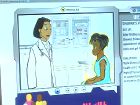
This morning NY1 reported about the work of the National Urban Technology Center, which is finding new ways to use technology to address sexual health issues among urban populations. Here's a short excerpt from the piece:
A computer-based program called "Prom Night," created by the National Urban Technology Center is being introduced in some city schools to help supplement the Department of Education's updated HIV/AIDS curriculum just revamped about a year ago.
Using a variety of animated games and scenarios, it's meant to use day-to-day situations students can relate to learn how to talk and think about the prevention of HIV and AIDS and other sexually transmitted diseases.
“We have designed this in a way that's very hard-hitting, that deals with youth in their own culture,” says Pat Bransford of National Urban Technology Center. “We use hip hop, for example, in our animated films. We have animated characters, teenagers, like themselves, who are dealing with these issues – it gives them a chance to have more of a discussion.”
Very innovative combination of technology and urban health education!
MacArthur Foundation & Digital Media

I haven't been posting here too much lately because I've been busily involved with the MacArthur Foundation series on Digital Media & Learning (DML). The foundation recently announced a new, $50 million dollar initiative to look at the ways new media influence the way young people learn. In line with that new initiative, the foundation is publishing a series of edited volumes on a variety of topics. The initiative also includes a number of online projects, including an online discussion forum, wiki (for members of the intiative), and the Spotlight on DML Blog, which is a cool place to follow some of the work in the series. And, here's my recent entry over there, about race online. One of my colleagues and fellow authors in the volume on "Race and Ethnicity," Mohan Dutta, has an interesting entry about underserved youth and online health activism, that is very worthwhile reading.
Wednesday, October 11, 2006
Bringing Global Health Data to Life
We often talk about trying to find better, more innovative and engaging ways of sharing complex thoughts, ideas and data with large groups of other people. Thanks to Jenna Mandel-Ricci who shared this video in PH 710. The video clip (simlar to YouTube for those of you familiar with that) is a brief (7 minutes, with brief commercials at the beginning and end) presentation by Dr. Hans Rosling, a professor of international health at Sweden’s world-renowned Karolinska Institute, and founder of Gapminder, a non-profit that seeks to "bring vital global data to life" by developing and distributing free software. Rosling demonstrates some of this software in his presentation about global health, discusses a little about the vision of his non-profit organization, and is clearly energetic and enthusiastic here in this talk, recorded February, 2006 in Monterey, CA. The occasion is The Technology Entertainment Design Conference, also known as TED, an annual conference self-described as "a global community of remarkable people and remarkable ideas." Dr. Rosling sets a new benchmark for us all in terms of presentation of complex data in easy to understand ways.
CLICK THIS LINK TO WATCH THE VIDEO.
CLICK THIS LINK TO WATCH THE VIDEO.
Friday, July 28, 2006
eHealth Literacy and Internet Interventions: New Articles from JMIR

The Journal of Medical Internet Research is frequently a good resource for material on health-related technology research. A couple of recent articles are especially noteworthy.
A paper titled, "Internet Interventions for Long-Term Conditions: Patient and Caregiver Quality Criteria," by Cicely Kerr, Elizabeth Murray, Fiona Stevenson, Charles Gore, and Irwin Nazareth (J Med Internet Res 2006 (Jul 28); 8(3):e13), explores a patient-generated analysis of an online intervention.
And, a paper titled, "eHealth Literacy: Essential Skills for Consumer Health in a Networked World," Cameron D Norman, Harvey A Skinner (J Med Internet Res 2006 (Jun 16); 8(2):e9), reviews some of the important skills necessary for evaluating health information online.
Thursday, July 20, 2006
HIV Risk and Latino Gay Men: Free Web Seminar
I just got an email notice about a free web seminar with one of the leaders in the field of research on HIV risk among Latino gay men, Dr. Rafael M. Diaz. Here's the notice:
Understanding Latino Gay Men and HIV Risk: A Conversation with Dr. Rafael M Díaz
About this Web Seminar:
Latino gay men continue to be disproportionately affected by HIV/AIDS. Acción Mutua will host a web-based seminar to explore the contexts that put Latino gay men at risk for HIV infection/transmission. More importantly, we will discuss factors that help Latino gay men remain safe, healthy and strong and other issues around resiliency.
Who should sign up?
* Anyone working to prevent new infections/transmissions of HIV among Latino gay men and other men of color
* Anyone seeking to understand the social and cultural context of HIV risk
* Anyone who wants to explore what makes Latino gay men resilient in the face of the HIV/AIDS epidemic
Participants in this seminar will discuss:
Ø The social and cultural context of what it means to be a Latino gay man
Ø The impact of racism, homophobia, and poverty on Latino gay men
Ø How to build upon Latino gay men's individual and collective strengths
*Seminar approach:
We encourage participants to submit questions in order to make the seminar interactive and responsive to their particular concerns. Submit questions between now and the day of the seminar to accionmutua@apla.org; entitle theemail "7/25 Seminar Questions."
Details:
This web seminar is FREE. Participants will log in to the appropriate website and call a toll free number to participate in the discussion.
RSVP: Please sign up by email at accionmutua@apla.org
You will receive instructions on how to log in and what number to call after you register.
DATE: Tuesday, July 25, 2006
TIME: 2:00-3:00 pm (Eastern time)
This is a great opportunity for any one interested in knowing more about HIV risk to learn from one of the leaders in the field.
Understanding Latino Gay Men and HIV Risk: A Conversation with Dr. Rafael M Díaz
About this Web Seminar:
Latino gay men continue to be disproportionately affected by HIV/AIDS. Acción Mutua will host a web-based seminar to explore the contexts that put Latino gay men at risk for HIV infection/transmission. More importantly, we will discuss factors that help Latino gay men remain safe, healthy and strong and other issues around resiliency.
Who should sign up?
* Anyone working to prevent new infections/transmissions of HIV among Latino gay men and other men of color
* Anyone seeking to understand the social and cultural context of HIV risk
* Anyone who wants to explore what makes Latino gay men resilient in the face of the HIV/AIDS epidemic
Participants in this seminar will discuss:
Ø The social and cultural context of what it means to be a Latino gay man
Ø The impact of racism, homophobia, and poverty on Latino gay men
Ø How to build upon Latino gay men's individual and collective strengths
*Seminar approach:
We encourage participants to submit questions in order to make the seminar interactive and responsive to their particular concerns. Submit questions between now and the day of the seminar to accionmutua@apla.org; entitle theemail "7/25 Seminar Questions."
Details:
This web seminar is FREE. Participants will log in to the appropriate website and call a toll free number to participate in the discussion.
RSVP: Please sign up by email at accionmutua@apla.org
You will receive instructions on how to log in and what number to call after you register.
DATE: Tuesday, July 25, 2006
TIME: 2:00-3:00 pm (Eastern time)
This is a great opportunity for any one interested in knowing more about HIV risk to learn from one of the leaders in the field.
Pew Report on Bloggers
There's a new Pew Internet and American Life study out, about bloggers:
"The Pew Internet Project blogger survey finds that the American blogosphere dominated by those who use their blogs as personal journals. Most bloggers do not think of what they do as journalism. Most bloggers say they cover a lot of different topics, but when asked to choose one topic, 37% of bloggers cite “my life and experiences” as a primary topic of their blogs. Politics and government ran a very distant second with 11% of bloggers citing issues of public life as the main subject of their blog. Entertainment-related topics were the next most popular blog-type, with 7% of bloggers, followed by sports (6%), general news and current events (5%), business technology (4%), religion, spirituality or faith (2%), a specific hobby or a health problem or illness (each comprising 1% of bloggers). Other topics mentioned include opinions, volunteering, education, photography, causes and passions, and organizations."
Of interest here, is the part I put in bold above, a "specific ... health problem or illness" which makes up 1% of bloggers. An interesting juxtaposition to another finding from the Pew about the fact that health-related information is one of the most often searched for items in people's internet use. Taken together, I think this can only mean that health-related blogs are going to increase over time.
"The Pew Internet Project blogger survey finds that the American blogosphere dominated by those who use their blogs as personal journals. Most bloggers do not think of what they do as journalism. Most bloggers say they cover a lot of different topics, but when asked to choose one topic, 37% of bloggers cite “my life and experiences” as a primary topic of their blogs. Politics and government ran a very distant second with 11% of bloggers citing issues of public life as the main subject of their blog. Entertainment-related topics were the next most popular blog-type, with 7% of bloggers, followed by sports (6%), general news and current events (5%), business technology (4%), religion, spirituality or faith (2%), a specific hobby or a health problem or illness (each comprising 1% of bloggers). Other topics mentioned include opinions, volunteering, education, photography, causes and passions, and organizations."
Of interest here, is the part I put in bold above, a "specific ... health problem or illness" which makes up 1% of bloggers. An interesting juxtaposition to another finding from the Pew about the fact that health-related information is one of the most often searched for items in people's internet use. Taken together, I think this can only mean that health-related blogs are going to increase over time.
Friday, July 14, 2006
Visionary Behind Wifi in Parks
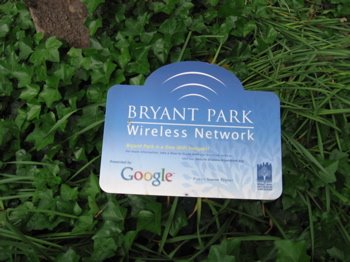
Personally, I can't wait for the wifi spots in Central Park to go live so I'm following this story closely. In this morning's NYTimes, there's a piece about Marshall Brown the visionary behind the wifi project for the city's parks, who "dreams of the wireless bubble on a grandiose scale," according to the article. I thought this quote from Brown was interesting:
“The first end of Internet expansion was about globalization, but this second phase of wireless Internet is going to be about the Internet made local.” His niche: for example, “What we’re going to enable by installing our portals in the parks is for people to get more in touch with where they happen to be.”
Brown also seems to have a desire to adddress some educational issues with this technology. The wifi hotspot just activated in Battery Park will usher users in through a portal that will offer a historical slide show, a tour of the Dutch gardens, and a video-cam hookup to the Statue of Liberty. As the article states, "In Mr. Brown’s wireless neighborhoods, connectivity is accompanied by educational content."
That's an interesting concept, providing educational content via portals at the free wifi spots. And, it seems like a great opportunity for the City Department of Health, or others interested in public health, to get out a message.
Wednesday, July 12, 2006
Black Gay Bloggers Protest Homophobia

Ran across this in Newsday.
"A reggae concert meant to raise awareness about HIV/AIDS is coming under fire from some black gay bloggers and activists who are incensed that the lineup includes two artists they consider to be anti-gay.
Among those scheduled to perform at the July 18 show at Webster Hall are Jamaican dancehall artists Beenie Man and the group T.O.K. Protesters have asked the concert's organizer, LIFEbeat - The Music Industry Fights AIDS, to drop them or force them to publicly denounce controversial lyrics in their songs.
'The idea that they would invite artists who encourage murdering gays and lesbians is so outrageous, insulting and unbelievable,' activist Keith Boykin said.
But concert organizers, while rejecting the anti-gay lyrics, said including the commercially successful performers in the show would allow them to reach an audience they otherwise wouldn't get to, pointing out that dancehall, a beat-driven form of Jamaican music, remains hugely popular despite controversy over its lyrical content.
John Canelli, LIFEbeat's executive director, said he felt strongly that the performers' presence would 'create dialogue around AIDS and the Caribbean-American community" and an "opportunity for groundbreaking change and good to come from it.' The artists aren't being paid, he said."
Subscribe to:
Posts (Atom)